
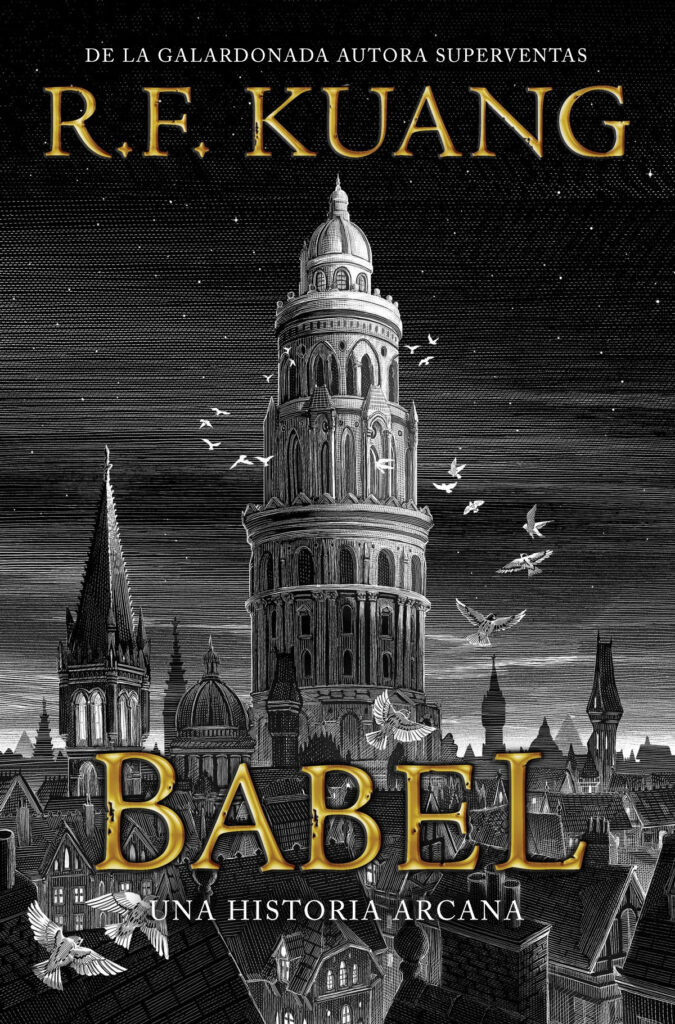
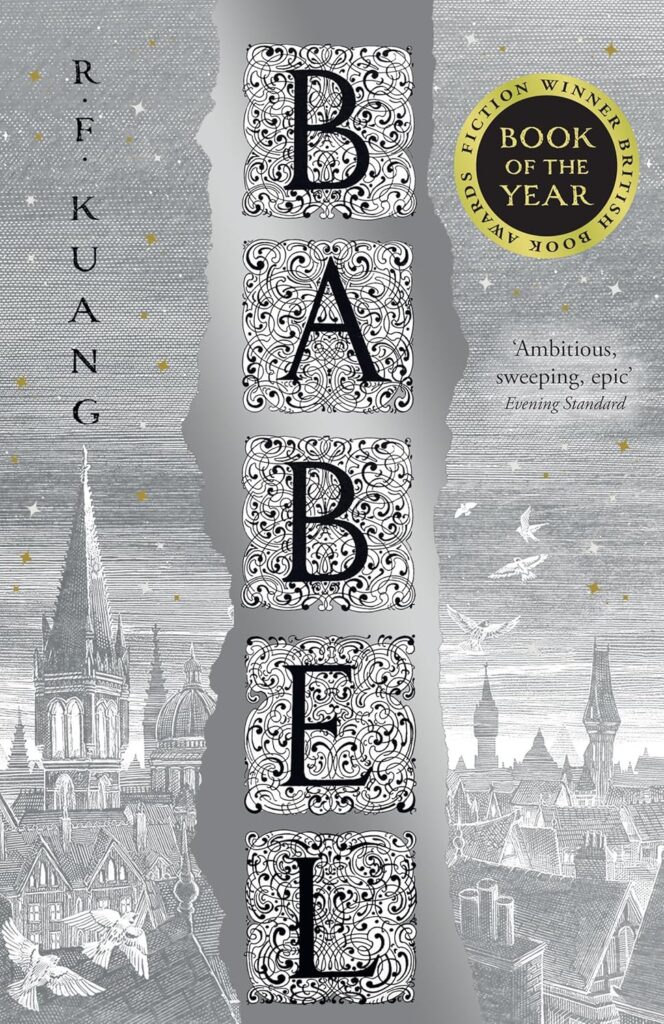
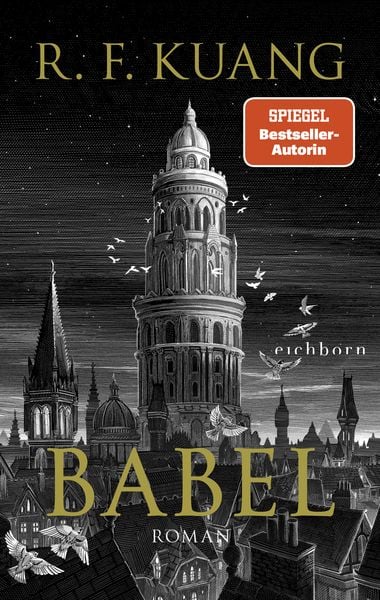
✅ Status: Read — I recommend it (with reservations)
📚 Dark academia · Historical fantasy · Standalone · 700 pages · 2022
The story (spoiler-free)
1828. Oxford. The Royal Institute of Translation — Babel — is the most powerful magical institution in the world. Its secret: when we translate a word from one language to another, something of the original meaning is inevitably lost — because the perfect translation does not exist, it never does. And it is precisely those untranslatable spaces, that loss of meaning, that engraved onto silver bars become magic. That power has turned the British Empire into an unstoppable force.
Robin Swift is a Cantonese orphan whom a mysterious professor takes from Canton to London, where he spends years studying Latin, Ancient Greek, and Chinese with one single goal: to enter Babel. But when he finally arrives, he discovers that serving the tower means betraying his own origins. And that between Babel and the clandestine Hermes Society — dedicated to stopping imperial expansion — he will have to choose. When Britain threatens to start an unjust war with China, Robin will face the hardest dilemma of his life.
Why was it on my list?
I live my life in three languages. I'm a philologist, translator, and editor — and I've always believed, deep down, that words are magic. So when I heard there was a novel where the meaning lost between languages is literally the foundation of a magic system... it took me all of zero seconds to add it to my TBR. This book had my name on it from the start.
What the reading community says
Opinions are fairly divided — and I understand why. Those who love it highlight the immersive world, the complex characters, and that magic system built on etymology and translation: an idea so original it's hard not to fall for it. Those who are more critical point to the slow pacing, a protagonist who doesn't always convince, and moments where the author explains the same ideas over and over, as if she doesn't quite trust her readers. Where almost everyone agrees: it's not an easy read — but it's one that stays with you.
What I actually thought (spoiler-free)
Seven hundred pages, and let's be honest: the pacing is slow, especially in the first third. But if you're someone who enjoys world-building, dense atmosphere, and ideas that keep circling in your head long after you've closed the book — then that slower pace stops being a flaw and becomes part of the experience.
What I loved most is the magic system. As I mentioned in the synopsis, the silver bars work by capturing the difference in meaning between two words in different languages — what one tongue says and another simply cannot say in quite the same way. It's a philological concept turned into magic, and personally, I find it absolutely fascinating. There are moments where Kuang analyses how the meaning of the same root shifts across Latin, Ancient Greek, medieval English, and modern English — and I was there underlining and grinning to myself like the language nerd I am (and I love being that nerd!). That said, if linguistics isn't really your thing, some sections might feel a little heavy going.
The supporting characters really shine, and I absolutely love them. Robin, the protagonist, was the one I had the hardest time warming to—I won't lie. Sometimes he seems a bit like an afterthought: things happen to him, but he doesn't cause them, he lacks initiative. Those around him, on the other hand, are complex, realistic, and very well-developed. And I get the feeling, reading between the lines, that at some point during the revisions, quite a few scenes between them were cut—which is a shame. I miss that more intimate glimpse into their relationships.
Something I didn't expect: I thought Babel was mainly about translation and language, but the critique of British colonialism is brutal. There are things that I — someone who has studied the history of English-speaking countries — simply hadn't considered before. Some ideas are still rattling around in my head, and I'm not going to tell you which ones, because I don't want to spoil it for you. Food for thought. Genuine, proper food for thought.
Is this book for you?
✅ For you if you love languages, etymology, British imperial history, characters facing impossible moral dilemmas, or the dark academia genre.
❌ Maybe not for you if you're after fast-paced action, a central romance, or a more classic fantasy with creatures and heroes.
Fun fact
R. F. Kuang is also a translator — and a doctoral candidate in East Asian Languages and Literatures at Yale. It's no coincidence that this book is, among other things, a love letter to translation as a profession. And an indictment of how power has always used it for its own ends.
My rating: ⭐⭐⭐⭐ / 5
Not a book for everyone — but if you're a language nerd with a soft spot for etymology, it might just be the book you were looking for. Four stars because I'm quite particular and the pacing and Robin didn't fully win me over. And if I weren't a languages obsessive, it would probably be three. The fact that I'm giving it four says a lot about the book — and quite a bit about me too.
Have you read it? What did you think? Tell me below. 👇


 EN
EN  ES
ES  DE
DE